
The Digital Humanities Dialogue for Students – 2nd edition
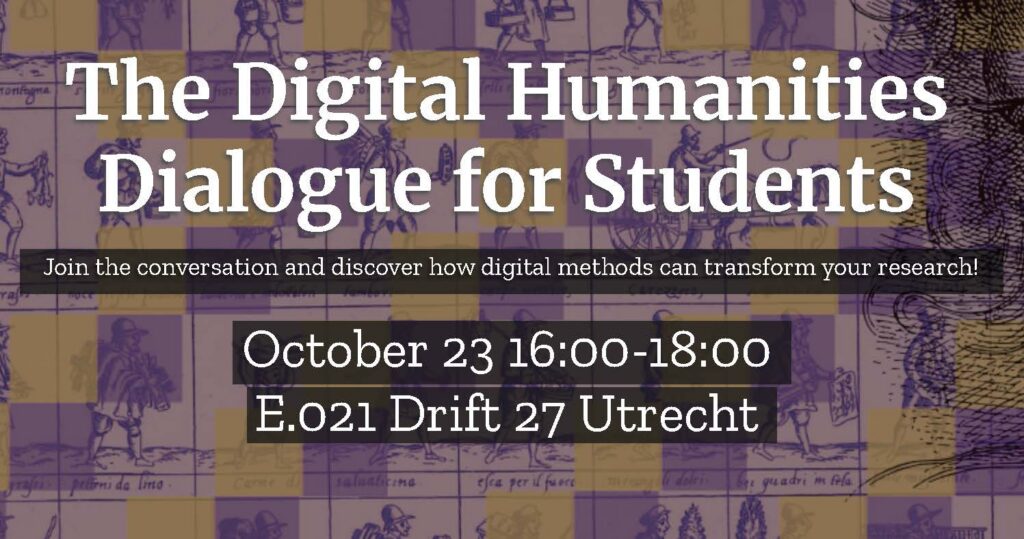
Could digital methods help you unlock something new with your humanities studies? Come and find out at The Digital Humanities Dialogue on 23 October!
Have you ever wondered how digital research methods could be useful for your research? Or are you already using digital methods and curious to hear about the experiences of others?
At this event, fellow students and PhD researchers will share how they have used digital methods in their own humanities projects. Whether you already work with digital methods or are simply curious about what they can do, this is a chance to discover new ideas. There will be coffee and plenty of room for discussion!
Why digital methods in the humanities?
There are many digital methods out there that can enrich research in the humanities. Whether it’s for a thesis, another project, or even a small assignment, digital methods can be great tools to unlock new avenues for your research.
At the same time, digital methods can feel like a daunting topic to pick up: they seem complicated and inaccessible, or simply difficult to imagine how to use. Our speakers will demonstrate how they use digital methods in their research projects in the humanities.
The event offers plenty of room for discussions, so that you can exchange ideas with other students and inspire each other to try out new methods.
Speakers
Weijie Huang (PhD, Media and Cultural Studies)

Digital media are increasingly woven into multiple aspects of everyday life, bringing together how we communicate, socialise, play, and understand ourselves and others. This paper, “Belongingness and Resistance in Platformed Play: Feminist Agency among Female Gamers in China,” explores this shift through Chinese female gaming communities, examining how women create belongingness and respond to gendered gaming experiences across Chinese social media platforms. Methodologically, the project uses qualitative netnography to analyse 343 multimodal posts, including text, images, and videos, from Chinese social media platforms including Douban, Xiaohongshu, and Bilibili, combining cross-platform digital observation with reflexive thematic analysis and multimodal discourse analysis.
Celis Tittse (PhD, Medieval History)

How did the material conditions of medieval book production shape the evolution of handwriting? Although the transition from Caroline minuscule to Gothic Textualis is well documented, its codicological influences remain on the level of hypotheses. Focusing on fused letterforms in twelfth-century England, this study combines a revised version of Kwakkel’s 2012/2018 dataset (n = 105) with data from the Catalogues of Dated Manuscripts to test established explanation models based on economic pressure, readability, and textual density. The results show no evidence for demand-driven and text-density models, identifying chronology and textual genre as the strongest correlates of fusion. Benchmarking Kwakkel’s corpus against 1,550 contemporary manuscripts reveals no significant differences in the codicological features examined, but exposes an overrepresentation of English manuscripts and liturgical, historical, and legal texts, which demonstrates both the explanatory power and the limits of quantitative codicology and palaeography.
Victor Elgersma (MA, History, Philosophy of Science)

How did the Victorian press respond to a controversial theory about the origin of the solar system? The anonymously published Vestiges of the Natural History of Creation (1844) argued for the nebular hypothesis, the idea that the solar system condensed from a cloud of luminous matter. Victor compared reviews of the book in seven British periodicals published between 1844 and 1846. He shows that each paper interpreted the theory through its own politics and faith, so that arguments about cosmic origins became arguments about political reform, morality, and who had the right to speak for science. Most of these reviews are in the public domain but survive only as hard-to-read page scans. Using the open-source OCR engine Tesseract, and cleaning up the output with the help of ChatGPT, Victor turned them into plain-text and HTML transcriptions, now freely available at plainoldtext.vjbe.net. Every newspaper citation in his essay links to its full source, so readers can check whether they agree with Victor’s interpretation, and reuse the originals in their own work. The archive Victor created is open source and on Github, so anybody can contribute their own digitizations.
In this talk, Victor will dive into his method of turning these scans into plain text files, and how he hosts them on the web.
Sign up
The event is free, but please register via the form below.