
Lecture + demo: Olifant – An efficient, explainable, and eco-friendly approach to Large Language Modeling
In this online lecture and accompanying demo, Antal van den Bosch will demonstrate Olifant, a recently revived language model that offers an energy-efficient alternative to Large Language Models (LLMs). Participants are welcome to join the lecture and/or the demo.
Olifant is an efficient and eco-friendly alternative to deep neural network-based language modelling. It is not a new discovery; rather, this 20-year old idea was recently revived and reprogrammed to demonstrate the existence of less greedy, yet scalable technical solutions to language modelling.
Olifant offers scalable next-token prediction performance, requiring RAM and CPU, and no GPU, along with strong memorization capabilities. Training Olifant is estimated to consume about a factor 1000 less electricity than Transformer-based LLMs. Its internal workings are simple and fully transparent.

Content
- 15:30 – 16:00: Talk
- 16:00 – 16:45: Demo
In the lecture and subsequent demo, Van den Bosch will present Olifant’s key features and demonstrate how to work with it: how to train and finetune new models, and how to run and apply trained models.
For whom?
The lecture and demo are open to all.
Level
Working with Olifant requires some basic programming skills (Python) and familiarity with Jupyter Notebook. Code and notebooks are provided.
About
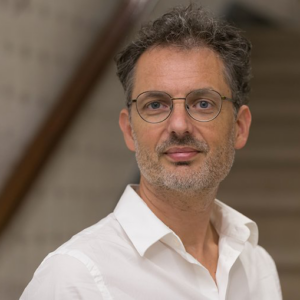
Antal van den Bosch is professor of Language, Communication and Computation at Utrecht University. He is board member and domain chair social sciences and humanities at NWO. His research focuses on machine learning and language technology, with an emphasis on the intersection of the two fields: computers that learn to understand and generate natural language, nowadays known as Generative AI and Large Language Models.